Prayers for Fasting: A Comprehensive Guide to Spiritual Nourishment and Strength
Feb 10, 2026

Share at


© 2025 Baymed Limited. All rights reserved.
Feb 10, 2026
Share at
Fasting is one of the most ancient and powerful spiritual disciplines in the Christian tradition. From the forty-day fasts of Moses and Elijah to Jesus’ own journey into the wilderness, the act of abstaining from food has always been a primary means of sharpening the soul’s focus on God.
However, anyone who has ever attempted a fast knows that it is rarely a walk in the park. As the physical body begins to hunger, the mind often follows with irritability, exhaustion, and distraction. Without a robust prayer life to support it, fasting can quickly devolve into a mere "diet" or a test of physical willpower.
To truly unlock the spiritual benefits of this discipline, you must pair your hunger with Prayers for Fasting. When we pray while we fast, we are not just empty; we are being filled with the Holy Spirit. This guide offers a deep dive into the theology of fasting, practical tips for the journey, and a collection of prayers to sustain you when the hunger sets in.

Before diving into specific prayers for fasting, it is essential to understand why we do it. In the modern world, we are taught to satisfy every urge immediately. If we are hungry, we eat. If we are bored, we scroll. If we are uncomfortable, we seek distraction.
Fasting flips this script. It is a voluntary "no" to the body so that we can say a louder "yes" to the spirit.
Fasting reminds us of our creaturely status. It teaches us that "Man does not live by bread alone, but by every word that comes from the mouth of God" (Matthew 4:4). When our stomachs growl, it serves as a physical alarm clock, reminding us to turn our thoughts to the One who sustains our very existence.
In the Catholic tradition, fasting is often linked to penance. It is a way of making satisfaction for sin and purifying the heart from attachments to worldly pleasures. By denying ourselves legitimate goods (like food), we strengthen our "spiritual muscles" to resist illegitimate goods (sin).
Fasting adds "weight" to our petitions. Throughout history, Christians have fasted when seeking a specific breakthrough—for the healing of a loved one, for clarity in a major life decision, or for peace in the world. As St. Augustine famously said, "Fasting cleanses the soul, raises the mind, subjects one’s flesh to the spirit, renders the heart contrite and humble... and pierces the clouds of heaven."
Whether you are observing a strict Lenten fast, a Daniel Fast, or a private day of penance, these prayers will help you redirect your physical hunger toward spiritual growth.
Setting the intention at the start of the day is crucial. This prayer asks for the grace to persevere.
"Heavenly Father, today I offer You this fast. I choose to abstain from [food/specific item] not as a display of my own strength, but as an admission of my weakness. I am hungry for You, Lord. As my body feels the lack of food, let my soul feel its need for Your grace. Guard my tongue today so that I do not become irritable or proud. Let this fast be a secret between You and me, performed in humility and love. Amen."
There is usually a moment—often mid-afternoon—when the fast feels impossible. Use this prayer as a "breath prayer" during those difficult moments.
"Lord Jesus Christ, You fasted forty days and forty nights in the wilderness and were hungry. You understand my weakness. When my body cries out for food, give me the bread of life. Strengthen my resolve. Let this hunger pang be a prayer for [insert intention]. Your grace is sufficient for me, for Your power is made perfect in my weakness. I trust in You. Amen."
Many people fast when they are at a crossroads. This prayer asks God to use the fast to clear the "static" of daily life.
"Spirit of the Living God, move upon the waters of my soul. In this time of fasting, I seek Your wisdom. Remove the distractions that cloud my judgment. Quiet the noise of my desires. As I empty my stomach, I ask You to fill my mind with Your truth. Speak, Lord, for Your servant is listening. Show me the path You have laid out for me. Amen."
If you are fasting for someone else, use this prayer to offer up your sacrifice on their behalf.
"O God, I offer this sacrifice of fasting for the sake of [Name]. I place their needs, their suffering, and their soul into Your hands. May the merit of this small penance, united with the sacrifice of Your Son on the Cross, bring them healing and peace. Accept my hunger as a plea for Your mercy to rain down upon them. Amen."
A common mistake is jumping into a 24-hour water-only fast without preparation. To maintain a prayerful heart, you must also be wise with your body.
If you have never fasted before, don't start with three days. Try skipping one meal and spending that time in prayer. Gradually work your way up to a full day (from dinner to dinner).
Unless you are doing a "black fast" (which is rare and should be done under spiritual direction), drink plenty of water. Dehydration leads to headaches, which make it very difficult to pray.
The most important rule of fasting is that you must replace the time spent eating with time spent praying. If you usually spend 30 minutes on lunch, spend those 30 minutes in a quiet chapel, with your Bible, or using a spiritual tool.
Living a disciplined life is hard in a world of constant notifications. Many find that having a structured plan helps them stay on track. For instance, the Manna app is an excellent companion for those engaged in spiritual disciplines like fasting. Manna provides more than just text; it offers an interactive community and guided Bible studies that can keep your mind occupied with the Word of God during those hours when you might otherwise be thinking about your next meal. It’s a practical way to ensure your fast remains a spiritual exercise rather than just a physical challenge.
Not all fasts look the same. Depending on your health, your schedule, and your spiritual goals, you might choose one of these methods:
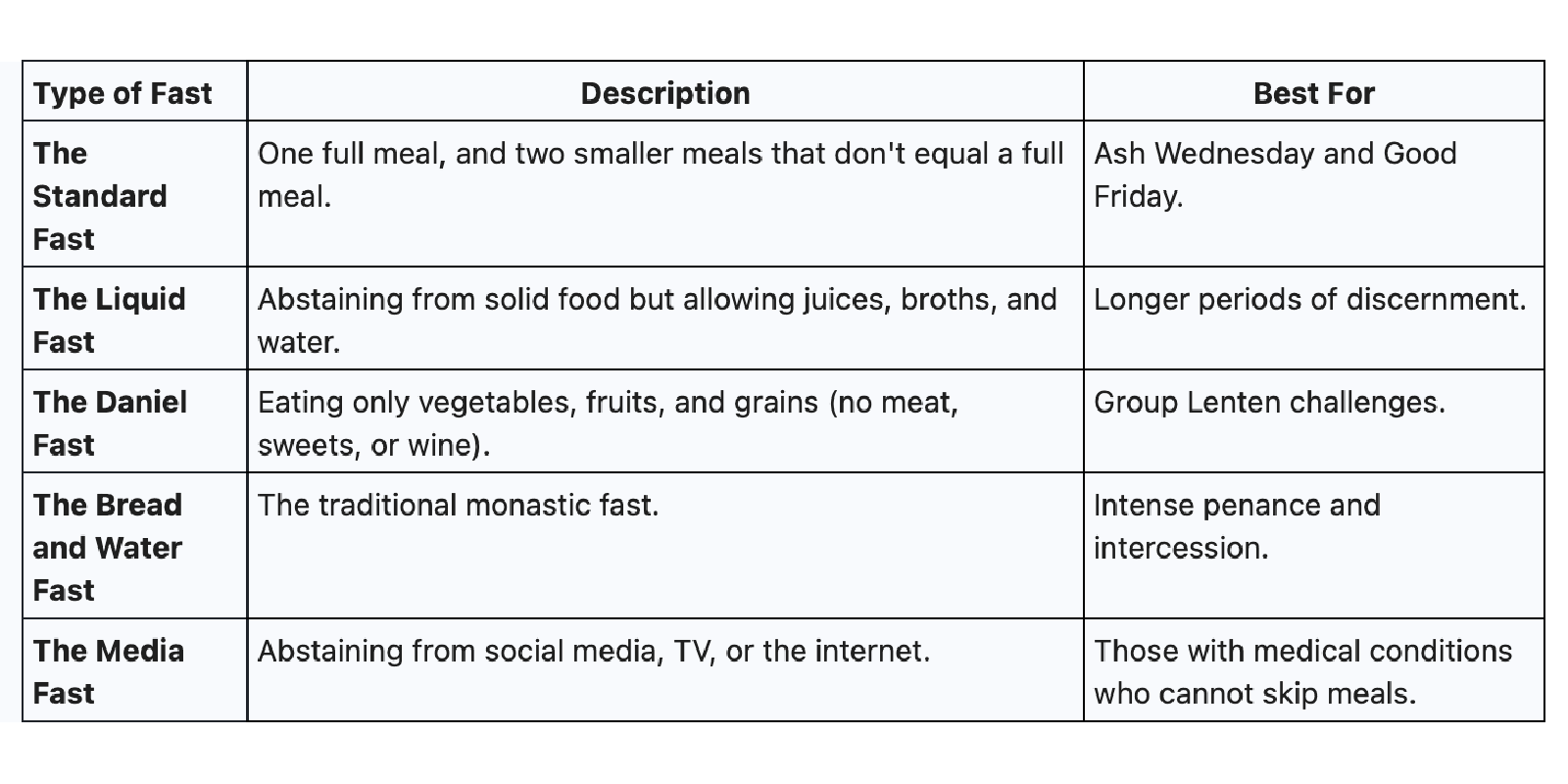
When you are praying, it helps to have the Word of God as your foundation. Here are several passages to read and reflect upon during your fast:
"Is not this the fast that I choose: to loose the bonds of wickedness, to undo the straps of the yoke, to let the oppressed go free, and to break every yoke? Is it not to share your bread with the hungry and bring the homeless poor into your house..."
Reflection: True fasting must lead to charity. If our fast makes us mean to our family but "pious" toward God, it is an empty fast.
"And when you fast, do not look gloomy like the hypocrites... But when you fast, anoint your head and wash your face, that your fasting may not be seen by others but by your Father who is in secret."
Reflection: Fasting is an act of intimacy between you and God. Keep it quiet. Don't complain about your hunger to others; tell it to the Lord.
"As a deer pants for flowing streams, so pants my soul for you, O God. My soul thirsts for God, for the living God. When shall I come and appear before God?"
Reflection: Use your physical thirst and hunger as a metaphor for your soul’s longing.
We are not the first to struggle with fasting. The Saints are masters of this discipline and can offer us their intercession and wisdom.
St. Catherine of Siena: Known for her extreme fasts, she lived for long periods on nothing but the Holy Eucharist. She taught that when we strip away physical food, we become more sensitive to the "food of the soul"—God's will.
St. Francis of Assisi: He often fasted for forty days at a time on islands or in caves. For Francis, fasting was a way to embrace "Lady Poverty" and to align himself with the suffering of Christ.
St. John Vianney: The patron saint of parish priests, he lived on little more than a few boiled potatoes a day. He believed that the devil is most easily defeated by prayer and fasting.
The most common " casualty" of fasting is the person who eats a cookie at 3:00 PM and then decides, "Well, I ruined the whole day, I might as well eat a steak dinner."
This is a trap of the enemy.
If you slip up during your fast, do not give up. Simply pray a prayer of humility:
"Lord, I am weak and I faltered. Thank You for showing me how much I need You. I am starting again right now. Accept my small effort, despite my failure."
God is a Father, not a taskmaster. He is more interested in the movement of your heart than the perfect execution of a schedule.
When you finish a period of fasting supported by prayers for fasting, you will often find that you have a new perspective. The problems that seemed insurmountable before the fast often appear smaller. Your "spiritual ears" become more attuned to the promptings of the Holy Spirit.
Fasting is a reset button for the soul. It clears the clutter, humbles the ego, and prepares us for the feast. Whether you are preparing for Easter or seeking a personal breakthrough, remember that your hunger is a holy thing. Offer it to God, sustain it with prayer, and watch how He transforms your emptiness into a deeper fullness than food could ever provide.
Would you like me to create a specific 7-day Lenten prayer plan for you, or perhaps provide a list of nutritious "fasting-friendly" recipes that comply with traditional abstinence rules?


